Voyage Vic
Launch promo ends in 00:00:00
Get the Book — $47 $27
Voyage Vic ——— eleven years of crew contracts · four lines · sixty ships

The problem is not the cruise. It is the second cruise fare.

The one assembled on board out of drinks packages, photographs, internet minutes, excursions, spa treatments and specialty dinners — and that routinely runs as much as the ticket did. This is an operations manual, not a travel brochure: how the money works, who gets paid, and what to do differently, written from the other side of the desk.

Instant download · Yours forever

30Chapters
149Pages
11Years at Sea

Voyage Vic
"For the galley, the engine room, the laundry, and everyone else on Deck Zero who makes the holiday upstairs possible." From the dedication

I · The Book

An operations manual, not a travel brochure.

Every chapter explains how a piece of the cruise business actually functions, what it costs you when you do not know, and what to do differently.

I spent eleven years working ships. I started on the bottom rung in a galley, moved through guest services, worked a casino floor, and finished up in shore excursions — which is the department where you learn what everything on land really costs and what the ship marks it up to. Four cruise lines, more than sixty ships between the training and the contracts, and somewhere north of four hundred embarkation days.

I have checked in a great many people who were about to spend two thousand dollars more than they needed to, and I have watched most of them do it.

Let me be straight about my angle, because everyone writing about cruising has one. I am not anti-cruise. I think a cruise is one of the last genuinely good deals in travel. A week of transport, accommodation, food and entertainment for what a mid-range hotel alone would cost you on land is a real bargain, and the people who sneer at it have usually never done the arithmetic.

"The problem is the second cruise fare — the one that gets assembled on board and routinely runs as much as the ticket did. That second fare is where the industry makes its money. It is designed by very capable people to feel painless."

So that is what this book is. Not a list of ports. Not a review of ships. A working explanation of the money, the queues and the routines, written by someone who was on the other side of the desk — so that you can spend your money on the parts of the holiday you actually want.

Where something costs money, I say how much. Where a trick does not work, or only works on some lines, or stopped working in 2023, I say that too. Where I think the cruise line is in the right and the passenger is in the wrong, I say that as well — and there are more of those chapters than you might expect.

II · The Difference

The same week at sea, priced two ways.

Every line below is the same mistake: paying for something you already own, or buying it at the moment the ship chose for you. Here is the same voyage, made both ways.

What most passengers do
What this book has you do
Book it and never look at the price again
Re-price your existing booking before final payment — fifteen minutes, typical return $0–$600 — Quick-Start Map
Buy bottled water twenty feet from a water station
The forty-five things you have already paid for, listed — Chapter 08
Take the drinks package because it "must" be worth it
The arithmetic nobody does — the break-even number for your actual drinking — Chapter 06
Assume gratuities are a tip and remove them
Where the money actually goes, and who it comes out of — Chapter 05
Book the ship's excursion because it feels safer
The honest comparison — when the ship is genuinely worth it, and when it is not — Chapter 23
Pick a cabin by price and deck number
Reading a deck plan: the cabins nobody chooses, and why they are quiet — Chapter 17
Queue at the terminal with three thousand people
Embarkation day, timed against the ship's own rhythm — Chapters 20–21
Find out what the casino offer meant in January
How the "free cruise" offer actually works — Chapter 12
III · What's Inside

The full contents — 149 pages, 30 chapters, ten parts.

The contents are grouped by the problem they solve, not by the order of the voyage. Each chapter is short on purpose: read one on the train and act on it that evening. Every one opens with the situation, explains the mechanism, gives you the method, then the honest limits — and most finish with the arithmetic.

Front Matter

The Quick-Start Savings Map

  • Three things you can do in about an hour, on land, before you pack
  • Re-pricing a booking you have already made
  • Typically returns $300–$1,200 on a seven-night cruise for two
Part I

Before You Book

  1. What you are actually buying when you buy a cruise
  2. When cruise fares actually move, and how to be there
  3. Guarantee cabins, upgrade bids, and the upsell call
  4. The nine charges nobody warns you about until you are aboard
Part II

The Onboard Account

  1. Gratuities: where the money actually goes
  2. The drinks package arithmetic nobody does
  3. Wi-Fi, photographs, and three other quiet margins
Part III

What Is Already Paid For

  1. Forty-five things you have already paid for
  2. The included food map, deck by deck
  3. Free ashore: what you do not need an excursion for
Part IV

The Casino

  1. Fifteen things the ship's casino would rather you knew later
  2. How the "free cruise" offer actually works
  3. A casino budget that survives to Friday
Part V

Food and Drink

  1. Eleven things I would not eat at sea
  2. How the buffet really works, and the twenty good minutes
  3. Ordering like the crew would
Part VI

Your Cabin

  1. Reading a deck plan: the cabins nobody chooses
  2. The first fifteen minutes in the stateroom
  3. Packing for a ship, not for a hotel
Part VII

Lines and Crowds

  1. Embarkation day: beating the terminal
  2. The ship's rhythm: where three thousand people are at any hour
  3. The last morning, without the misery
Part VIII

Ports and Shore Days

  1. Ship excursion or independent: the honest comparison
  2. The port day playbook
  3. Missing the ship: how it happens and what to do
Part IX

How the Ship Works

  1. Twelve things that are true of every ship
  2. Who is who behind the name badge
  3. Staying well: motion, outbreaks, and the medical centre
Part X

Mistakes and the Long Game

  1. Ten mistakes the crew still talk about
  2. The repeat cruiser's long game
Appendix

The Working Papers

  • The Cruise Cost Worksheet
  • The Seven-Day Countdown Checklist

How every chapter is built

  • The situation — what happens to most passengers, and why.
  • The mechanism — who gets paid, what the ship is optimising for, what the system was designed to do.
  • The method — what you do differently.
  • The honest limits — where it breaks, and which lines it does not work on.
  • The arithmetic — the numbers, in dollars, current to 2026.
Get the Book — $47 $27

Instant download · Yours forever

IV · Reader Results

What readers came back and said.

★★★★★

"I did the re-pricing thing in the first chapter on a cruise we booked in March. Four hundred and ten dollars back, on a booking I thought was finished. That paid for the book about fifteen times over."

Denise R. · Ohio

★★★★★

"Chapter six talked me out of the drinks package and I was annoyed about it until I added up the bar bill on the last night. Forty-one dollars under what the package would have cost. My husband still will not admit it."

Marion T. · Kent, UK

★★★★★

"Nine cruises in and I did not know half of what is in the 'already paid for' list. We ate better this trip and spent less doing it. The bit about the buffet's twenty good minutes is worth the money on its own."

Frank & Julia P. · Florida

V · About

Who is writing this.

Voyage Vic

Eleven years on ships. Galley first, because everyone starts somewhere, then guest services, then a casino floor, and finally shore excursions — the department that teaches you what a thing costs ashore and what the ship charges for it.

Four cruise lines. More than sixty ships between the training and the contracts. Somewhere north of four hundred embarkation days standing at a desk watching people make the same handful of expensive decisions in the same order.

I do not name and shame. Partly because I still know a great many people who work at these companies and I would like them to keep their jobs, and partly because it would date the book inside a year. Policies move constantly. What does not move is the underlying economics — and that is what I have written down. If you understand why a ship prices a drinks package the way it does, you will still be able to work out the right answer in 2031, on a line that does not exist yet.

Do not try to use all thirty chapters on one voyage. Pick the three that address whatever annoyed you most last time, use those, and see what happens to the final statement. A cruise you have over-engineered is not a holiday, it is a project — and the whole purpose of the exercise is to enjoy the week.

Voyage Vic Somewhere with a balcony · 2026
VI · The Book

Thirty chapters from eleven years of crew contracts.

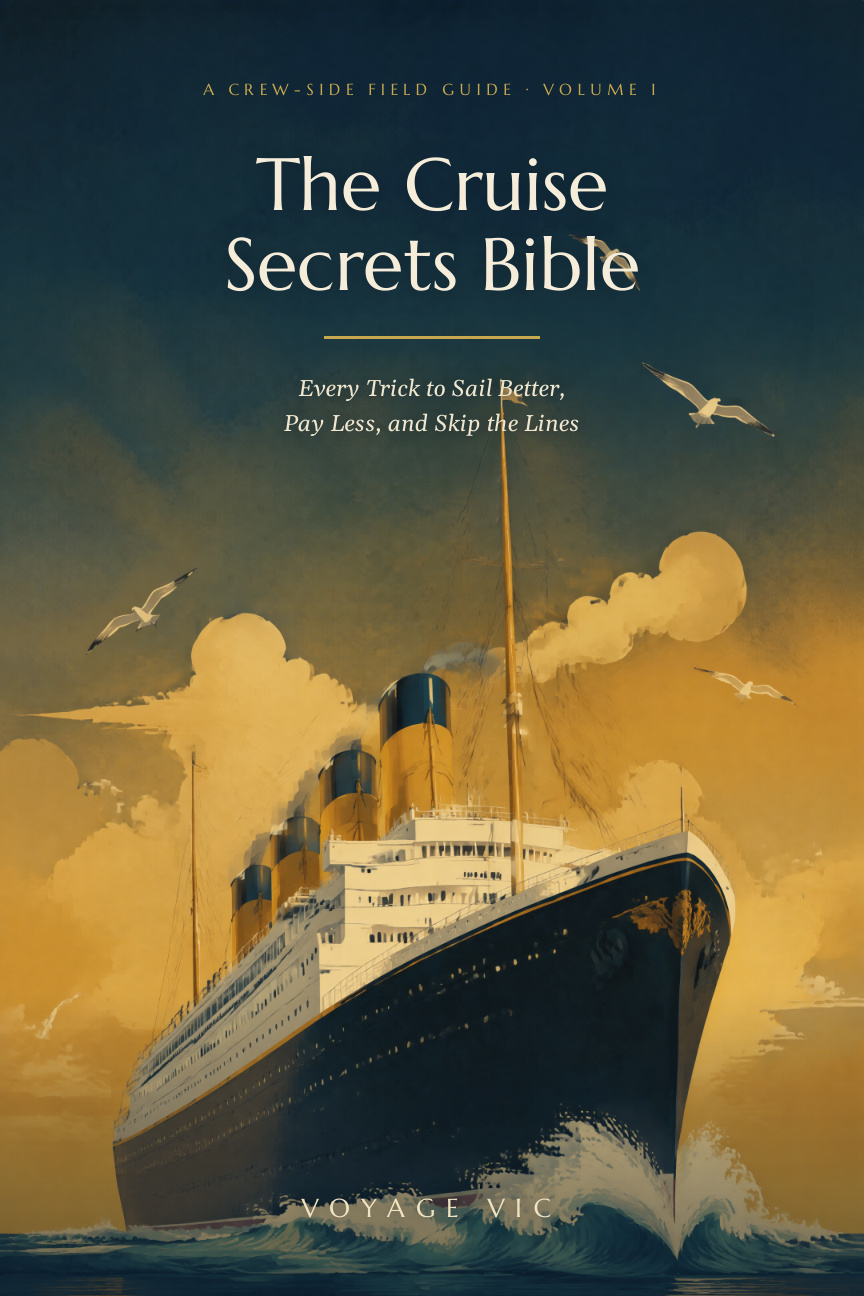
The Cruise Secrets Bible
Every trick to sail better, pay less, and skip the lines
The Cruise Secrets Bible — cover
  • The complete book — 30 chapters across 10 parts, 149 pages
  • The Quick-Start Savings Map — three things to do before you pack
  • The Cruise Cost Worksheet — what your week will actually cost
  • The Seven-Day Countdown Checklist
  • Every figure in US dollars, current to 2026, with the arithmetic shown
  • PDF — reads on phone, tablet, laptop, or printed
$47$27
USD · one payment
Get the Book — $47 $27

Instant download · Yours forever

Visa · Mastercard · Amex · PayPal
VII · Questions

Before you buy.

Did you really work on ships, or is this repackaged from the internet?

Eleven years, four lines, sixty-odd ships — galley, guest services, casino floor, shore excursions. That last department is the one that matters most for this book, because it is where you see both numbers: what a thing costs on land and what the ship charges for it. I do not name the companies, for reasons I explain in the book, so you will have to judge it the way you would judge any trade manual — by whether the mechanisms it describes match what you have seen with your own eyes on deck.

Your videos are free. Why would I buy the book?

Some of this comes from videos I have posted. Most of it goes considerably further, because a video has to end and a chapter does not. A video can tell you the drinks package is often a bad deal; the chapter gives you the break-even arithmetic for your own drinking, the four situations where the package genuinely wins, and the lines where the maths is different. The book is also organised — thirty chapters grouped by the problem they solve, which is not something a channel can do for you.

Why only $27?

Because the book pays for itself the first time you use one chapter, and I would rather it were read than admired. The Quick-Start Map alone typically returns $300 to $1,200 on a seven-night cruise for two. $27 is the launch price; $47 is where it sits afterwards.

What format is it, and how do I get it?

A PDF, delivered the moment you pay. It reads well on a phone, a tablet, a laptop, or printed out and shoved in a carry-on. There is no app, no login, and no subscription. Download it, keep it, take it aboard.

I have cruised a dozen times. Is there anything here for me?

Chapter 30 is written for you specifically, and so is most of Part IV. But the chapter I would point a veteran at is the forty-five things you have already paid for — it is the one that surprises experienced cruisers most often, because the industry has unbundled steadily and what was included in 2015 is not what is included now. The direction of travel is worth knowing.

Are the prices in the book going to be accurate for my sailing?

Treat every number as a well-informed baseline to check against, not a quote. Cruise pricing moves, daily service charges rise most years, and package prices change by season, ship and itinerary. When I give a range, the low end is a value line on a short Caribbean sailing and the high end is a premium line on a long or remote itinerary. The point of the range is to tell you the order of magnitude — so when a number comes at you on board, you know instantly whether it is normal, high, or absurd.

Does this cover river cruising?

No. River cruising is a different industry with different economics and it is outside the scope of this book. Everything here is drawn from mainstream ocean lines sailing the Caribbean, the Mediterranean and Alaska. Premium and luxury lines run differently, and I flag it where the difference matters.

Get the Book — $47 $27

Instant download · Yours forever

Voyage Vic
Wait — one thing

Less than one drink at the pool bar.

A cocktail on deck runs $14 before the service charge. This is thirty chapters on where the rest of that money goes — and how to keep it. The first chapter alone typically returns $300 to $1,200 on a week at sea.

Get the Book — $47 $27 or see what's inside →